Saturday, 18 October 2008

Diabetes gonna get you

About 10 days ago Diabetes UK launched their biggest ever UK public awareness campaign - Beware the silent assassin. I first got wind of the campaign when I spotted this arresting poster at Old Street tube station in east London.

The campaign has been launched on the back of research by Mori showing that people tend to underestimate the severity of the complications associated with diabetes; for example, only 29% of adults are aware of the link between diabetes and heart disease, and only 46% appreciate that diabetes shortens life expectancy. Diabetes UK says, "This research tells us that the public see diabetes as rather mild and easily managed – something of an inconvenience rather than the serious condition it can be."

In addition, an estimated 500,000 people in the UK have the condition but are not aware of it, so are at risk of being diagnosed too late to prevent the complications of diabetes. “Dealing with the diabetes time-bomb is a matter of urgency if we want to prevent millions of people from facing a grim future of ill-health," said Douglas Smallwood, Chief Executive of Diabetes UK.

The 'hard-hitting campaign' launched by the charity aims to spook the public into realizing that diabetes is serious condition that can potentially cause heart disease, stroke, amputations, kidney failure and blindness.

The images, which will appear on outdoor posters as well as in newspapers and magazines, feature an ominous ghostly figure - the specter of undiagnosed diabetes presumably - pouncing on unsuspecting members of the public. The ads also include secondary warning messages such as:
- Diabetes causes more deaths than breast and prostate cancer combined.
- The death certificate will say heart attack. It was really diabetes.
- Diabetes causes heart disease, stroke, amputations, kidney failure and blindness.
So far so portentous.

The campaign also encourages people at risk of developing type 2 diabetes, i.e. the overweight, to make changes in their lifestyle to avoid a future of chronic disease. As the blurb states, "With early diagnosis and by leading a healthier lifestyle and improving diabetes control, the risk of developing these serious complications can be minimised. "

The adverts refer readers to a microsite developed especially for the campaign, which has quizzes to help users establish their risk of developing diabetes and gives information and support on managing the condition.

I personally feel that these adverts suggest that diabetes could to strike you dead on the spot - assassinate you - the way heart disease might, but is this really the case? On the other hand, a campaign educating our increasingly overweight population that diabetes is a serious and mostly preventable disease is certainly needed, and it is quite likely that striking adverts such as these will get people thinking more seriously about their health.

Saturday, 11 October 2008

Herbal remedies and acute kidney disease

Nature Clinical Practice Nephrology has recently published a review by Luyckx and Naicker highlighting the link between traditional medicines and kidney injury.

Traditional and herbal remedies are widely used worldwide, with as many as 80% of people in some populations using such treatments. The use of herbal remedies becoming increasing common in Western countries, as shown by a 2002 survey that found that 36% of people in the US use alternative or complementary medicines.

Herbal therapies all pass through the kidney on their way out of the body; consequently, many have been associated with acute kidney disease. Luyckx and Naicker report that "folk remedies account for up to 35% of cases of acute kidney injury and mortality rates for acute kidney injury range from 24% to 75%."

The herbal remedies most commonly used in the US include echinacea, which is used as an immunostimulant, and St John’s wort, which is used to treat depression among other things. Echinacea, however, has been associated with acute kidney injury and St John's Wort with kidney transplant rejection.

Various factors besides direct toxicity of the agent can contribute to kidney injury, such as contamination of the preparation or incorrect administration. In addition, the type of nephrotoxicity experienced by an individual taking a herbal remedy is dependent on which part of the kidney is affected, and the authors discuss these factors in more detail in their review.

Luyckx and Naicker do point out that the effects of herbal remedies are something of an unknown quantity; for example, some studies have shown that cranberry decreases the risk of kidney stones, whereas other studies find that cranberry increases this risk.

The review concludes by saying "The incidence and prevalence of acute kidney injury associated with the use of traditional remedies is unknown and probably varies greatly from place to place. Since the use of traditional remedies is common worldwide, it is probably safe to assume that the incidence of acute kidney injury is not high. Individual morbidity, however, can be considerable."

Friday, 10 October 2008

Skin test to detect Parkinson's disease

A recent study published in the Journal of Neuropathology & Experimental Neurology has shown that neural signs of Parkinson's disease can be identified by taking a simple skin sample.

Parkinson’s disease is a progressive neurodegenerative disease that affects about 1 in every 500 people in the UK. There is no biochemical test to definitively diagnose Parkinson's disease; diagnoses are instead made on the basis of various clinical assessments. Parkinson's disease is, however, characterized by the presence of Lewy bodies (LBs) - tiny protein deposits in nervous tissue.

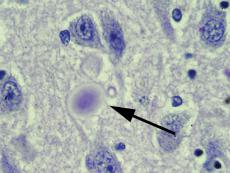
LBs can only be identified from a tissue sample, which is then stained and examined under a microscope (see right). These proteins tend to accumulate in the central nervous system and in the sympathetic ganglia, nervous tissue that runs like train tracks down either side of the spine - places that are nearly impossible to get biopsy samples.

In this study, the authors looked for LBs in various tissues in 279 patients undergoing autopsy. A total of 85 patients had evidence of LBs in their central nervous system, so were diagnosed as having had a LB disease (LBD) - Parkinson's with or without dementia, dementia with LBs or LB-related progressive autonomic failure.

The authors then examined skin biopsy samples taken the patients with proven LBD and found that 20 (23.5%) patients showed LB pathology in the cutaneous nerves of skin samples. None of the 194 individuals who did not have LBD showed evidence of LBs in skin samples; therefore, the skin test didn’t mistakenly identify any patients as having LBD.

More specifically, LBs were found in the skin of 70% of patients who had Parkinson’s disease with dementia and in 40.4% of those who had dementia with LBs. On the other hand, LB pathology was found in the skin of only 20% of patients who had subclinical LBD, i.e. patients who would have had few symptoms of LBD but not enough signs to meet all the criteria for a diagnosis. This skin biopsy test might not, therefore, be a useful test for early diagnosis in individuals suspected of having LBD.

When the authors looked at the clinical records of the patients that they had autopsied, they found that LBD patients who had evidence of LB pathology in their skin were more likely to have been bedridden and unable to walk independently before they died than were those patients with LBD who did not have cutaneous LB pathology (P<0.001 style="font-style: italic;">P=0.065, respectively). This finding suggests that skin biopsy testing could be used to predict which patients’ physical functioning might be affected most seriously by their disease, and physiotherapy could be prescribed accordingly.

Ikemura et al.’s study is the first to find evidence of LB pathology in the skin of patients with LBD; however, their results do not support the use of skin biopsy as an early diagnostic test. Testing for LBs in the skin could be used to confirm the diagnosis in a patient with clinical Parkinson’s disease or dementia with LBs and to predict the effect the disease might have on their physical functioning, both of which could help clinicians tailor treatment.

------------------------------------------------------------------------------------------------------------------
Ikemura M, Saito Y, Sengoku R, Sakiyama Y, Hatsuta H, Kanemaru K, Sawabe M, Arai T, Ito G, Iwatsubo T, Fukayama M, Murayama S (2008). Lewy Body Pathology Involves Cutaneous Nerves. J Neuropathol Exp Neurol, 67 (10), 945-953 PMID: 18800013

Monday, 6 October 2008

From homeopaths to psychopaths

To celebrate the launch of the book Medical London: City of diseases, city of cures, the Wellcome Collection is hosting a selection of events in the city. Written by Richard Barnett and Mike Jay, Medical London offers "a unique ... view of the roles played by diseases, treatments and cures in London's sprawling story". Yesterday I took part one of the Wellcome events - a walk around west London titled From homeopaths to psychopaths.

We started out in Sloane Square, where leader Max Décharné, author of King's Road, gave us a bit of background on the area. Throughout the 16th and 17th century, the Chelsea region served as a rural outpost of London, the clean air and clean water of the village a welcome reprieve for the visitors looking to recuperate from the filthy mêlée of the east end.

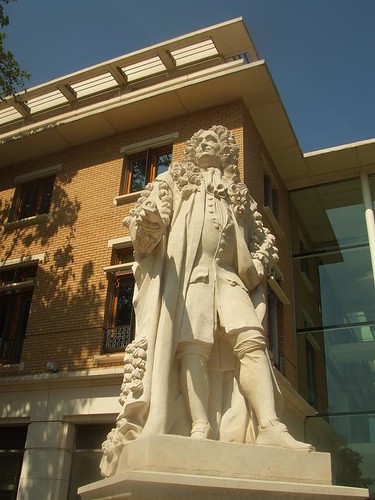
First stop was the statue of Hans Sloane, which stands outside of the Duke of York's Headquarters (Photo: Matt from London on Flickr). Sloane, born in 1660, was physician to Queen Anne, George I and George II and was the first medical practitioner to receive a peerage, given the title Baron in 1716. In clinical practice, Sloane promoted innovations such as inoculation against smallpox and the use of quinine (a treatment for malaria). He was also a president of the Royal College of Physicians and succeeded Sir Isaac Newton as President of the Royal Society.

As well as being a proficient doctor, Sloane was an avid collector of pretty much anything and everything, and on his death his vast collection of natural history specimens and antiquities was sold to the nation at a knock-down price and housed in the newly created British Library, and later at the Natural History Museum.

We next passed through Chelsea Walk, which was originally built by William III and intended as a wide boulevard linking the newly-built Royal Chelsea Hospital with Kensington Palace, but actually only extends from the hospital to King's Road.

The Royal Chelsea Hospital itself was commissioned by Charles II for the "succour and relief of veterans broken by age and war" (Photo: stevecadman on Flickr). Until the 17th century injured or elderly soldiers were not provided for in any way by the state. Many were kept on regimental rolls and still took part in duties so that they could continue to receive payment as there were no pension provisions. Charles II recognized that the state owed a debt to these soldiers, marking a shift from the tactic of previous kings who often left the poor and infirm to fend from themselves. The hospital was built by Sir Christopher Wren and completed in 1692, with the first 479 in-pensioners in residence by the end of the year. The hospital is still a home to elderly or injured British soldiers, and is also the site of the annual Chelsea Flower Show.

On the way to the hospital we passed Bram Stoker's house on St Leonard's Terrace, who, despite writing rather morbid literature, has an interesting health connection. In 1882 Stoker was awarded a Royal Humane Society Bronze Medal for attempting to save the life of a man who had jumped into the River Thames.

At this point I sadly had to abandon the walk as I had been totally soaked through by the torrential rain. I was particularly disappointed to miss the trip to Chelsea Physic Garden, not least because for many years I thought it was called Chelsea Psychic Garden and was hoping for some horticultural glimpse into my future (incidentally, the word ‘physic’ refers to the science of healing, not the science of matter and forces. So much opportunity for confusion). The garden was founded in 1673 as a site to train apothecary apprentices in the art of identifying plants and still hosts the Garden of World Medicine, a special collection of plants used for medicinal purposes by different cultures around the world.

Sunday, 5 October 2008

Not so Ignoble

On Thursday the Ig Nobel prizes were awarded at Harvard University. Sponsored by the Annals of Improbable Research, these prizes are an irreverent alternative to the Nobel Prizes, which will be awarded over the next ten days, and aim to "celebrate the unusual, honor the imaginative -- and spur people's interest in science, medicine, and technology".

This year the winners of the medicine prize were Dan Ariely of Duke University, Rebecca L Waber of MIT, Baba Shiv of Stanford University, and Ziv Carmon of INSEAD (Singapore), who demonstrated that high-priced placebos are more effective than low-priced placebos.

In their study, published in the Journal of the American Medical Association no less, 87 healthy, paid volunteers were told that they were receiving a new opioid analgesic; however, one group of patients was told that they were receiving a drug at its regular price of $2.50 per pill, whereas the other patients were told that they were receiving a discounted medication priced at $0.10 per pill. All patients then received a series of electric shocks before and after taking the placebo, supposedly to test the efficacy of this treatment. More patients in the regular price group than in the discounted price group said that the electric shocks were less painful after taking the drug.

Rather than being frivolous, this study sounds like it may be of some importance. Patients switching from expensive branded medications to generic drugs have a tendency to perceive that the generic equivalents are less effective, and some might actually experience reduced efficacy thanks to a negative placebo effect (or nocebo response). Healthcare providers could, therefore, incur unnecessary costs by keeping patients on brand drugs on the basis of perceived efficacy. Doctors could prevent this problem by playing down potentially deleterious commercial factors when discussing treatment options with their patients; for example, steering clear of terms like 'low-priced' and 'generic'.

To be fair, the overarching aim of the Ig Nobels Prizes is to "honor achievements that first make people laugh, and then make them think". The study by Ariely et al. certainly meets both criteria, as do several of the winning pieces of research.

Read more: Nature News has a blow-by-blow account of the raucous ceremony, while The Guardian celebrates Britain's double win.

Wednesday, 1 October 2008

Irresponsible reporting of clinical trials by the news media

It is important for journalists to highlight any potential bias in medical research so that patients and physicians alike can judge how valid clinical trial findings are. Today the Journal of the American Medical Association published a study showing that almost half of news stories on clinical trials fail to report the funding source of the trial. In addition, two-thirds of news articles refer to study medications by their brand names instead of by their generic names.

The authors Hochman et al. reviewed papers published between 1st April 2004 and 30th April 2008 in the top five medical journals (New England Journal of Medicine, JAMA, the Lancet, Annals of Internal Medicine and Archives of Internal Medicine) to find pharmaceutical-company-funded studies that evaluated the efficacy or safety of medications. They then searched 45 major US newspapers (for example New York Times and USA Today) and 7 US-based primary news websites (including ABC News, CNN and MSNBC) for news stories that reported these clinical trials.

A total of 358 company-funded clinical trials were identified, and 117 of these yielded 306 distinct news stories. Of the 306 news stories, 42% did not report the funding source of the clinical study. A total of 277 of these news articles were about medications that had both brand names and generic names, but 67% of stories used brand names in at least half of the references to the medication and 38% used only brand names.

By using a brand name in news articles instead of a generic name, journalists are inadvertently favouring one pharmaceutical company over another. For example, the cholesterol lowering drug atorvastatin (generic name) is manufactured by several different pharmaceutical companies who all give it a different brand name - Pfizer call it Lipitor, whereas Merck until recently marketed a version called Zocor. Drugs are often referred to by their brand name because these titles tend to be better known - you've probably heard of paracetamol but not of acetaminophen; fair enough, maybe, but this practice still represents biased reporting.

Hochman et al. also surveyed 94 newspaper editors to find out whether these individuals thought that their publication accurately reported clinical trials. Interestingly, 88% of editors stated that their newspaper often or always reported reported company funding in articles about medical research, and 77% said that their publication often or always referred to medications by their generic names.

It seems that news outlets think they are reporting funding sources in medical articles when actually they're not. Academic journals have strict policies for disclosing funding and potential conflicts of interest, so why don't newspapers follow suit?

---------------------------------------------------------------------------------------------------------------------
M. Hochman, S. Hochman, D. Bor, D. McCormick (2008). News Media Coverage of Medication Research: Reporting Pharmaceutical Company Funding and Use of Generic Medication Names JAMA: The Journal of the American Medical Association, 300 (13), 1544-1550 DOI: 10.1001/jama.300.13.1544